REVIEW · MUSEUMS
Ara Pacis Museum Entrance Ticket
Book on GetYourGuide →Operated by The Voyager · Bookable on GetYourGuide
A glass box, an ancient altar—perfect contrast. The Ara Pacis Museum is a modern enclosure built around Emperor Augustus’s ancient monument, and this ticket is designed to make entry feel painless with skip-the-line access and flexible hours. It’s a straightforward way to see imperial Rome’s sculpted story without locking yourself into a tight schedule.
What I like most is the pre-booked entrance that’s meant to save you time at the ticket office. I also like that this is an open ticket valid for 1 day, so you can pick the moment that fits your day rather than rushing to match a specific tour time.
One consideration: the museum experience is more focused than huge, and some people find it doesn’t feel like a lot for the money. Also, a small number of bookings have run into trouble using vouchers, so I’d keep your confirmation details handy and plan for a calm entry.
In This Review
- Key takeaways before you go
- Ara Pacis Museum entrance ticket: what you’re really paying for
- Augustus’s Altar of Peace in plain context (why this museum exists)
- Richard Meier’s glass museum: how modern architecture changes your view
- What to look for inside: friezes, restored pieces, and imperial Rome
- Timing your visit: using the 9:30 to 7:30 window wisely
- Skip-the-line entry and The Voyager support: making it frictionless
- Value check: is $29 a good deal for the Ara Pacis Museum?
- Who should book this ticket (and who might want a different approach)
- Should you book the Ara Pacis Museum entrance ticket?
- FAQ
- How much is the Ara Pacis Museum entrance ticket?
- How long is the ticket valid?
- Does this ticket include skip-the-line entry?
- What time is the museum open?
- Is a guided tour included with the ticket?
- Is an audio guide included?
- Is the Ara Pacis Museum entrance wheelchair accessible?
- Can I reserve now and cancel if plans change?
Key takeaways before you go
- Skip-the-line entry at the Ara Pacis Museum ticket office
- Open ticket (valid 1 day) with flexible entry hours
- Richard Meier’s glass pavilion frames Augustus’s Altar of Peace
- Imperial Rome friezes and restored sculpted artifacts to study at your pace
- Conveniently on the River Tiber, ideal for pairing with nearby walking plans
- Wheelchair accessible for visitors who need barrier-free access
Ara Pacis Museum entrance ticket: what you’re really paying for
This is a $29 per person entrance ticket for the Ara Pacis Museum in Lazio, Italy, with a 1-day validity window. The value here isn’t a guided itinerary. It’s the access format: you’re buying guaranteed entry with skip-the-line access plus an open ticket approach, so you can enter during the museum’s operating hours.
That matters because this museum sits in a busy part of central Rome. Even if you’re not trying to cram everything into a perfect schedule, skipping the ticket office line can turn a “maybe we’ll see it” plan into a real stop you can count on. And with flexible entry hours, you’re less likely to feel stuck if your morning runs late.
What’s not included is also important: there’s no guided tour, no audio guide rental, and no food or beverages. If you want a narration-style experience, you’ll need to bring your own approach—read the signs, study the sculptures closely, or pair it with another guided stop elsewhere in the day.
You can also read our reviews of more tours and experiences in Rome



Augustus’s Altar of Peace in plain context (why this museum exists)
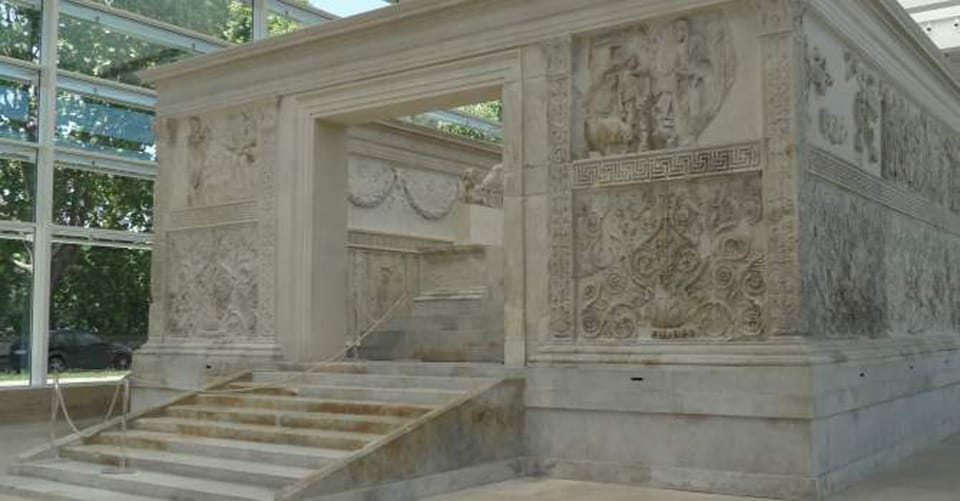
The Ara Pacis Museum centers on the Ara Pacis, the Altar of Peace, commissioned by Emperor Augustus in 13 BCE. That date alone is a clue: this isn’t just “ancient Rome,” it’s the Rome of Augustus—the emperor who reshaped the empire after decades of chaos.
The altar’s message was tied to peace and prosperity, which makes the name Ara Pacis more than a poetic label. The carvings and sculptural program are meant to communicate political power through art—showing who Augustus was, what Rome stood for, and how the empire wanted to be remembered.
Inside the museum, you’re not just looking at standalone artifacts. You’re seeing ancient Roman sculpture presented as a complete visual statement. The museum’s modern structure is part of the experience too, because it frames the altar in a way that helps you compare the ancient and the present-day at the same time.
Richard Meier’s glass museum: how modern architecture changes your view

One of the most compelling parts of this experience is the setting. The Ara Pacis Museum is housed in a modern glass structure designed by Richard Meier, which creates a strong visual contrast to the ancient altar itself.
That contrast is more than design trivia. It affects how you “read” the artifacts. In a typical outdoor ruin setting, your view is shaped by weather, distance, and crowds. Here, the museum approach keeps the experience controlled: you can take your time, reposition yourself, and study the sculpted surfaces without needing the perfect outdoor conditions.
Also, the museum’s glass framing tends to make the ancient forms feel staged, almost like they’re being presented to you with intention. If you like architecture, this stop becomes more than a history checkbox. You’re essentially seeing a negotiation between time periods—ancient politics in marble and a modern “container” built to protect and interpret it.
What to look for inside: friezes, restored pieces, and imperial Rome
The museum experience you’re paying for is essentially a guided-by-signs look at ancient sculpture and decoration. Expect to spend time with:
- Detailed friezes that depict scenes connected to imperial Rome
- Meticulously restored artifacts related to the altar and its sculpted program
- A clear visual focus on how the altar communicated meaning through art and layout
If you like Roman art, this is a good kind of museum. It doesn’t ask you to run from room to room. Instead, it rewards careful looking. I’d plan to slow down for the carvings—especially the repeating patterns and narrative sections—because the story sits in the visual details rather than in a checklist of “must see” objects.
Since there’s no audio guide included, you’ll rely on the museum labels to connect the images to their meaning. That’s not a dealbreaker, but it does change the style of your visit: you’ll get more out of it if you’re comfortable doing some reading and observation.
Timing your visit: using the 9:30 to 7:30 window wisely
The Ara Pacis Museum is open daily from 9:30 AM to 7:30 PM. With an open ticket, you can enter anytime within that window, which is a big help in Rome where plans often shift.
Here’s how I’d use that flexibility:
- If you’re touring other sites the same day, pick an entry time that won’t force you to sprint between stops.
- Use the long hours to avoid the stress of a tight schedule.
- Think of it as a calmer mid-to-late day art/history stop rather than something you squeeze at the last second.
Because the ticket is open for 1 day, you don’t need a “morning-first” strategy. You can build the rest of your day around how you feel. That flexibility is especially useful if you’re planning around other museum lines, meals, or transit timing.
And since the museum sits along the River Tiber, you can often weave it into a walk in that area without losing time. Even if you don’t build a full route around it, the location helps keep your day efficient.
You can also read our reviews of more museum experiences in Rome





Skip-the-line entry and The Voyager support: making it frictionless
This experience is built around skip-the-line access for the Ara Pacis Museum ticket office. In practice, that means you should spend your mental energy on where to stand inside the museum—not on queuing for a ticket window.
The provider listed is The Voyager, and the ticket is described as a smooth, supported entry experience. If you’re traveling with any uncertainty about timing, this kind of ticket structure is usually the safer choice compared with “we’ll figure it out on the spot.”
That said, there’s a real-world consideration worth planning for. Some bookings have reported entry problems with vouchers. I can’t tell you the exact cause from the information provided, but here’s the practical move: keep your booking confirmation accessible on your phone or printed, and make sure the details match the venue and date you’re using. If there’s any mismatch, entry can become a hassle when you’d rather be looking at the sculpture.
Value check: is $29 a good deal for the Ara Pacis Museum?
At $29 per person, you’re paying for three main things:
- Entry to a specific site (not a general sightseeing pass)
- Skip-the-line convenience
- Flexible hours under an open-ticket format
The value equation shifts depending on what you expect from a museum. If you want a long, guided, multi-hour program, this may feel short on content—especially since there’s no guided tour and no audio guide rental included. In that case, you might feel like you paid for access rather than interpretation.
But if you’re the kind of visitor who likes to look closely at art and architecture, the ticket can feel very reasonable. The Ara Pacis Museum is focused. You’re not paying for a huge variety of exhibits; you’re paying to see a specific masterpiece-level object in a specific presentation style—ancient altar plus modern architectural framing.
Also, the open hours help prevent wasted money. If your schedule shifts, you still have a chance to use the ticket that day, rather than losing the value because you were off by an hour.
Who should book this ticket (and who might want a different approach)
This Ara Pacis Museum entrance ticket is a good fit if:
- You want guaranteed entry without planning your whole day around a guided group time
- You enjoy ancient sculpture and want to spend time reading labels and studying the carvings
- You like architecture and want to see how a modern glass pavilion (by Richard Meier) frames something from 13 BCE
- You need a wheelchair-accessible option
It may not be the best fit if:
- You’re expecting a big museum with multiple rooms and lots of content depth beyond sculpture and friezes
- You want a narrated experience built into the ticket (since no guided tour and no audio guide rental are included)
- Your schedule is so tight you can’t reliably enter during open hours (though the long hours help)
Should you book the Ara Pacis Museum entrance ticket?
I’d book if you want a straightforward, access-first visit: skip-the-line entry, a 1-day open ticket, and a chance to see Augustus’s Altar of Peace in a striking modern glass setting. It’s a calm, focused stop for people who enjoy art, sculpture, and architectural context more than huge crowds of exhibits.
I’d think twice if you need a guided narrative to connect the scenes, or if you’re expecting a long, expansive museum day. In that case, plan to do some reading at your own pace, or pair it with another guided experience elsewhere.
If you do book, take one small precaution: keep your confirmation details ready to reduce the risk of entry problems tied to voucher mismatches. Then go in with the right mindset—this is a “look closely” kind of museum, and that style is where it pays off.
FAQ
How much is the Ara Pacis Museum entrance ticket?
It costs $29 per person.
How long is the ticket valid?
The ticket is valid for 1 day.
Does this ticket include skip-the-line entry?
Yes. It includes skip-the-line access at the Ara Pacis Museum ticket office.
What time is the museum open?
The Ara Pacis Museum is open daily from 9:30 AM to 7:30 PM.
Is a guided tour included with the ticket?
No, a guided tour is not included.
Is an audio guide included?
No, audio guide rental is not included.
Is the Ara Pacis Museum entrance wheelchair accessible?
Yes, the ticket is listed as wheelchair accessible.
Can I reserve now and cancel if plans change?
Yes. There’s free cancellation up to 24 hours in advance for a full refund, and you can reserve now and pay later (book your spot and pay nothing today).