REVIEW · DAY TRIPS FROM ROME
From Rome: Ostia Antica Guided Half-Day Trip by Train
Book on GetYourGuide →Operated by City Wonders Ltd. · Bookable on GetYourGuide
Roman port life still echoes at Ostia. I love the way this half-day trip turns archaeology into real street scenes, from busy harbor warehouses to bath mosaics. Ostia Antica feels close enough to touch that you can almost hear footsteps on the Decumanus Maximus.
What really makes it work is the pacing and the human guide. I also like that you get a small group (up to 12) and hit big stops without sprinting through them, and guides like Rob and Cat are known for telling the “how people lived” story while you walk. One consideration: it’s mostly on foot in an ancient site, and it’s not suitable for wheelchair users.
In This Review
- Key Things To Know Before You Go
- Meeting at Piramide and Riding Out to the Ruins
- Logistics tip that actually helps
- Ostia Antica’s Main Street: Walking the Decumanus Maximus
- Baths of Neptune and Mosaics You Can Actually Focus On
- The Amphitheater: Imagining 3,500 Spectators
- The Public Forica: Roman “Daily Life” You Can’t Fake
- Time at Ostia Antica: Why 3 Hours Feels Like the Right Amount
- Weather and walking reality check
- After the Tour: Choosing Ostia City or the Beach
- Price and Value: What $58 Buys You
- Who This Half-Day Trip Best Fits
- Quick Checklist: What to Bring
- Should You Book This Rome to Ostia Antica Guided Trip?
- FAQ
- How long is the trip from Rome to Ostia Antica?
- What’s included in the price?
- Where do I meet the guide in Rome?
- Can I stay in Ostia after the guided portion ends?
- Is the tour accessible for wheelchair users or strollers?
- Do I have a break during the tour?
Key Things To Know Before You Go
- Easy train access from central Rome keeps the morning simple and efficient.
- Three hours inside Ostia Antica is enough time to see the major highlights without feeling rushed.
- Stops that match everyday Roman life: commerce, public washrooms, baths, and the amphitheater.
- Small-group feel (12 max) makes it easier to ask questions and stay together.
- Beach time is optional if you want to extend the day in modern Ostia.
Meeting at Piramide and Riding Out to the Ruins

This is one of the smoother Rome-to-ruins trips because you handle transit by train, not by bus. Meet at Cafe Piramide near Piramide Metro (Line B, blue line). If you’re facing the metro, step to the right-hand side: the cafe sits in view of the train tracks and the station exit, marked by white umbrellas outside, and the guide team shows up with a City Wonders sign.
From Rome, the train ride is short—about 15 minutes—which matters because you’ll want that energy for the walk inside the archaeological park. The tour structure also includes a practical reset: a toilet break with time for a snack or drink at the snack bar.
You can also read our reviews of more guided tours in Rome


Logistics tip that actually helps
Plan to arrive at the meeting spot a few minutes early so you can get organized before the group boards. One very practical detail: at the end, the trip service finishes back in Rome at Piramide Metro Station (around 1:00 PM), and your return train is unescorted—though you do receive the train ticket.
Ostia Antica’s Main Street: Walking the Decumanus Maximus
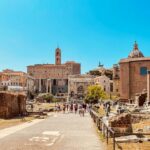
Once you’re inside Ostia Antica, the tour becomes a guided walk through a city people once worked, shopped, washed, and performed in. You’ll cover a main thoroughfare—the Decumanus Maximus—which is the kind of backbone street that helps you understand how the whole layout fits together.
This is where the guide earns their pay. Guides such as Alberto Terrasi and Alberto are noted for explaining what you’re looking at in plain terms, and that’s huge here because the site is large. With their explanations, you don’t just see walls and stones; you start to understand function—where people sold goods, where goods were stored, and how movement through the city worked.
The ruins themselves are unusually readable. You can see remains of taverns, thermal baths, warehouses, and theater spaces, and the fact that many elements are standing higher than you’d expect makes the scale feel more real. If you’ve already done a bigger site like Pompeii, Ostia’s advantage is that it can feel quieter and more “ordinary-city” in tone.
Baths of Neptune and Mosaics You Can Actually Focus On
One of the top stops is the Baths of Neptune, capped by an impressive mosaic showing the sea god pulled by a four-horse chariot. This is the kind of art you can pause for because it’s right there in your path—no guesswork about whether you’re seeing the best piece.
Why this matters for your experience: Roman bath culture wasn’t just hygiene. Baths were social spaces with routines, conversations, and status. A well-told guide makes that click fast, so the mosaic becomes more than decoration; it becomes proof of how much pride Romans put into shared public spaces.
Also, this stop breaks up the day nicely. After the commerce and street segments, you get a more atmospheric space—part architecture, part art, part social life.
The Amphitheater: Imagining 3,500 Spectators
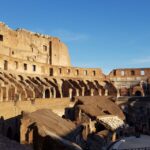
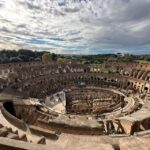
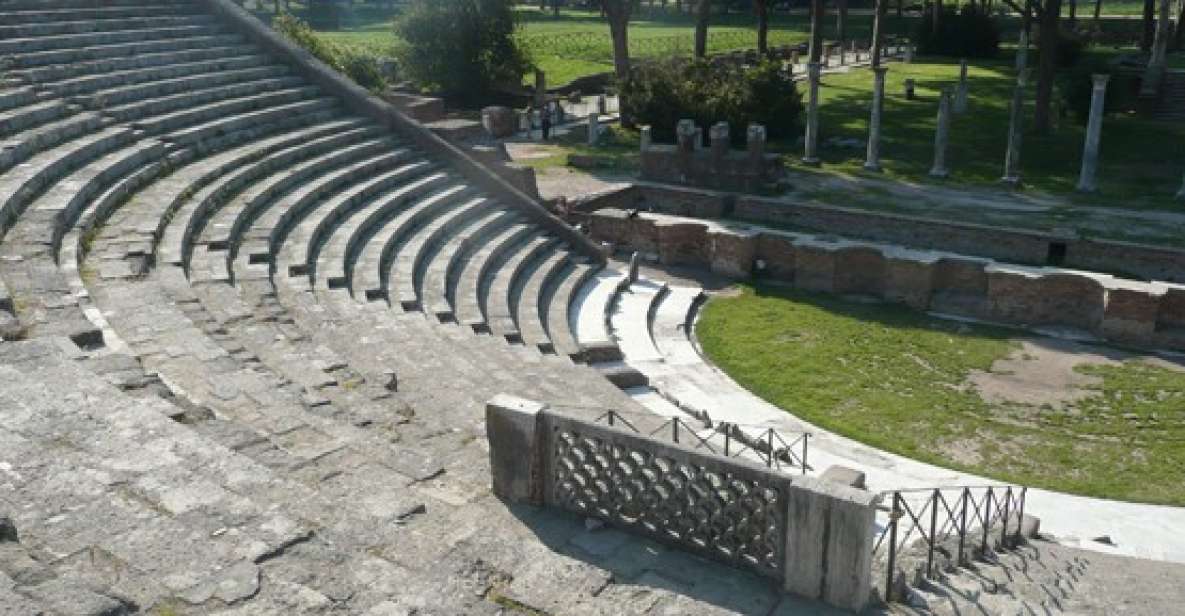
Another highlight is the amphitheater, built with seating capacity around 3,500 when it opened in 12 BC. Seeing the structure on-site helps you picture how crowds gathered and how performances would have worked in a real, close-to-home setting.
This is where Ostia Antica can surprise you. It isn’t as famous as Rome’s big arenas, but the feeling is similar once you’re in the stands. A guide helps you understand what kind of crowd energy the place would have carried—who would have shown up and what a day of events meant for city life.
If you’re someone who likes architecture and crowd logistics (where people enter, sit, and move), this portion is especially rewarding.
You can also read our reviews of more tours and experiences in Rome



The Public Forica: Roman “Daily Life” You Can’t Fake
If you want the most human stop on the route, make time for the Forica—the public washrooms. This room is famous for its marble bench lined with 20 evenly spaced holes across four walls, and the guide explains why that setup was normal enough to be communal.
This is not one of those “big monument” moments. It’s smaller, and it’s a little awkward—until you remember that this is exactly the kind of detail that makes history believable. When you experience it with context, you get a real sense for how Romans handled daily needs in shared spaces.
This stop also helps you appreciate something important about Ostia. It wasn’t a museum town built for tourists; it was a working city, and that shows in how everyday habits were built into public infrastructure.
Time at Ostia Antica: Why 3 Hours Feels Like the Right Amount
You’ll have about 3 hours on the site with the guide, wrapped into a total 4-hour outing including trains. That time balance is one of the best values here: you get major highlights without turning the day into an all-day slog.
A guide will keep the walk moving, but the tour typically includes short pauses so you can orient yourself, look around, and catch the details. People who enjoy asking questions tend to like small-group structure because it’s easier to stay connected with the guide rather than getting steamrolled by the pace of a large crowd.
Weather and walking reality check
Bring comfortable shoes. Ostia Antica is outdoors, and you’ll be moving across an archaeological park. In warmer months, having a plan for hydration and shade matters even if the pace is steady.
After the Tour: Choosing Ostia City or the Beach
At the end of your guided portion, you can either head back toward Rome with the group or stay in modern Ostia on your own for extra time. The tour service ends back in Rome at Piramide (around 1:00 PM), but you’re also free to explore more of the archaeological area yourself if you want.
One smart add-on: consider what you’d do with a few extra hours. If you’re in the mood for a calmer afternoon, modern Ostia can be a low-key contrast to Rome. And if the weather cooperates, the tour option includes time where you can go toward the beach—so you can mix ruins and relaxation without needing a separate transfer plan.
A guide can also point you toward the most logical way to continue on your own, so you don’t waste time figuring out logistics right after your tour ends.
Price and Value: What $58 Buys You
This trip costs $58 per person, and the value comes from what’s included. You get:
- a return train ticket from Rome to Ostia Antica
- entry into Ostia Antica
- a live English-speaking guide
When you compare that to the true cost of piecing together transport plus a standalone site ticket plus a guide, the price is easier to justify. Also, the guide component matters a lot at a site like Ostia, where the best experience comes from understanding what you’re seeing while you’re standing in front of it.
In particular, guides have a track record of making the port-city story feel clear and memorable. Some names you might hear in rotation include Rob, Cat, Liv, Laura, and Catarina, and the consistent theme is that they explain the why, not just the what.
Who This Half-Day Trip Best Fits
This is a strong fit if you want Roman history without committing to a full-day grind. It works especially well for:
- first-timers who want the “Roman life” angle, not only emperors and monuments
- people who like smaller crowds and a less frantic feel than the most famous sites
- anyone who appreciates mosaics and public architecture, including the baths and the Forica
It’s less ideal if you need wheelchair access, since the tour is not suitable for wheelchair users. And it also excludes baby strollers, so families with very young kids may need to plan differently.
Quick Checklist: What to Bring
This tour is short, but you still want to dress for the site and the beach option. Pack:
- comfortable shoes
- towel
- beachwear (if you plan to extend toward the beach)
- sports shoes (or shoes with good grip)
Also, plan for a snack/drink stop during the toilet break, since there’s time built into the schedule.
Should You Book This Rome to Ostia Antica Guided Trip?
Yes—if you want a high-ROI slice of ancient Rome that feels everyday, not only ceremonial. The mix of street life (Decumanus Maximus), public infrastructure (Forica), art in motion (Baths of Neptune mosaics), and performance space (amphitheater) makes the half-day structure feel satisfying.
Book it when your schedule is tight and you want help understanding the site without getting lost. Skip it only if you know you can’t do uneven walking, or if you need wheelchair access, since this one isn’t designed for that.
If you’re comparing this to other famous Roman-area ruins, I’d say Ostia Antica is the choice that often leaves you with a clearer sense of how Romans lived day to day.
FAQ
How long is the trip from Rome to Ostia Antica?
The total experience lasts about 4 hours, with around 3 hours spent on the guided tour at Ostia Antica.
What’s included in the price?
Your ticket includes the return train ticket between Rome and Ostia Antica, entry to Ostia Antica, and a live English guide.
Where do I meet the guide in Rome?
Meet at Cafe Piramide. It’s near the Piramide Metro station (Line B – blue line). Facing the metro, look to the right-hand side for the cafe with white umbrellas outside, and watch for a City Wonders sign.
Can I stay in Ostia after the guided portion ends?
Yes. After the tour, you can remain in Ostia Antica and the modern city at your leisure. If you choose to return, your train ticket back is provided, but the return journey is unescorted.
Is the tour accessible for wheelchair users or strollers?
No. The tour is not suitable for wheelchair users, and baby strollers are not allowed.
Do I have a break during the tour?
Yes. There will be a toilet break with time for a snack and/or a drink at the snack bar.