REVIEW · COLOSSEUM, FORUM & PALATINE TOURS
Rome: Wonders of Ancient Rome at Dusk
Book on GetYourGuide →Operated by Touriks · Bookable on GetYourGuide
Gladiators sound louder at dusk. This 2-hour Rome walk keeps you away from the daytime crush and uses sterilised headsets so you don’t miss the guide’s stories as you move between monuments. It’s built for night viewing, with classic sights like the Colosseum and Roman Forum—mostly from the outside—so you can understand what you’re looking at without getting stuck in long lines.
I especially like the pacing: the tour fits the big landmarks (Colosseum area, Roman Forum sights, Trajan’s Forum, and Capitoline Hill) into a compact route that doesn’t feel rushed. I also like the options—small group (up to 10) or private—so you can choose your comfort level. One thing to consider: you’ll get great viewpoints, but this experience does not include entering the Colosseum, Roman Forum, or Trajan’s Forum.
In This Review
- Key highlights
- Rome at dusk: why this 2-hour walk works so well
- Price and value: what $81 buys you (and what it doesn’t)
- Where to meet near the Colosseo metro (so you don’t waste your evening)
- Outside the Colosseum: construction, spectacle, and how to read the site
- Arch of Constantine to the Forum: shifting from emperor branding to civic life
- Roman Forum highlights: Temple of Castor and Pollux, the Arch of Titus, and the Senate House vibe
- Trajan’s Forum and the Column of Trajan: a photo moment with actual context
- Capitoline Hill finale: getting your bearings from the top
- Guides and groups: what small group or private feels like
- Who this tour suits best (and who should skip it)
- Should you book Rome: Wonders of Ancient Rome at Dusk?
- FAQ
- How long is the Rome: Wonders of Ancient Rome at Dusk tour?
- Does the tour include entrance into the Colosseum, Roman Forum, or Trajan’s Forum?
- Where do I meet the guide?
- What languages are available for the live guide?
- Is there a small group option, and how many people are in it?
- Is the tour wheelchair accessible?
- What should I bring?
- Does the tour run in rain?
Key highlights
- Dusk timing for Rome’s monuments with fewer daytime crowds
- Outside viewing of the Colosseum and Roman Forum with clear explanations
- Trajan’s Forum photo moment at the Column of Trajan
- Capitoline Hill climb capped by a panoramic view
- Professional guide + sterilised headsets to hear every detail on the move
- Multi-language tours (English, Italian, Spanish, Portuguese, French, German)
Rome at dusk: why this 2-hour walk works so well
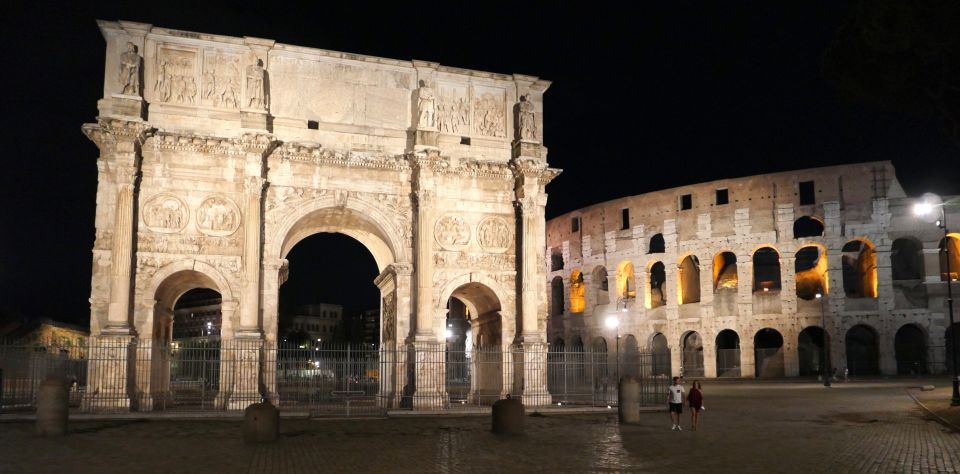
Rome’s ancient ruins look different when the light changes. At dusk, the hard midday glare softens, and the monuments feel more human—less like a postcard, more like a place where real people lived, worked, argued, and sometimes fought for their lives.
This tour is short on purpose: 2 hours is enough time to cover the key zones around the Colosseum and Forum without turning your evening into a marathon. The route also keeps you moving through the most important political and entertainment landmarks, so you’re not just ticking off sites—you’re seeing how Roman power and spectacle connected.
And you’re not doing it in a sea of people. The whole idea is to get you out of the daytime crowd rhythm and into an evening pace, where the guide can actually talk and you can actually look.
You can also read our reviews of more tours and experiences in Rome.
Price and value: what $81 buys you (and what it doesn’t)
The listed price is $81 per person for a 2-hour guided experience. That cost covers the guide, sterilised headsets, and on-site assistance, plus taxes and fees. In other words, you’re paying for interpretation and logistics—someone handling the flow so you can focus on understanding what you’re seeing.
What you’re not paying for is entry into the big-ticket interiors. The tour explicitly does not include admission to the Colosseum, Roman Forum, or Trajan’s Forum. So if you’re hoping to walk inside those spaces, plan to book separate tickets or pair this with another visit.
For many people, that’s the sweet spot. If your main goal is context—who ruled, what happened there, how the sites functioned—an outside-focused tour can be excellent value. You get the “why” in a tight timeframe. Then, if you want the “what it’s like inside,” you can add that later with timed entry.
Where to meet near the Colosseo metro (so you don’t waste your evening)
This tour starts at P.za del Colosseo, 21, right by the Colosseo metro area. Meet at the green kiosk at street level outside the Colosseo metro station on Line B (blue line). Staff will be holding a yellow Touriks sign.
One small but important detail: there’s also an upper exit from the metro. Meet downstairs. Arrive 30 minutes early. Rome is great, but signage and crowd flow can be chaotic when you’re on a schedule.
If you want to make the start easy on yourself, do this: find the right platform exit first, then give yourself time to reach the kiosk calmly. The tour’s whole tone is better when you’re not rushing.
Outside the Colosseum: construction, spectacle, and how to read the site
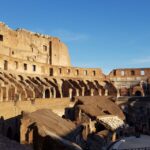
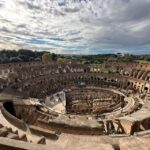
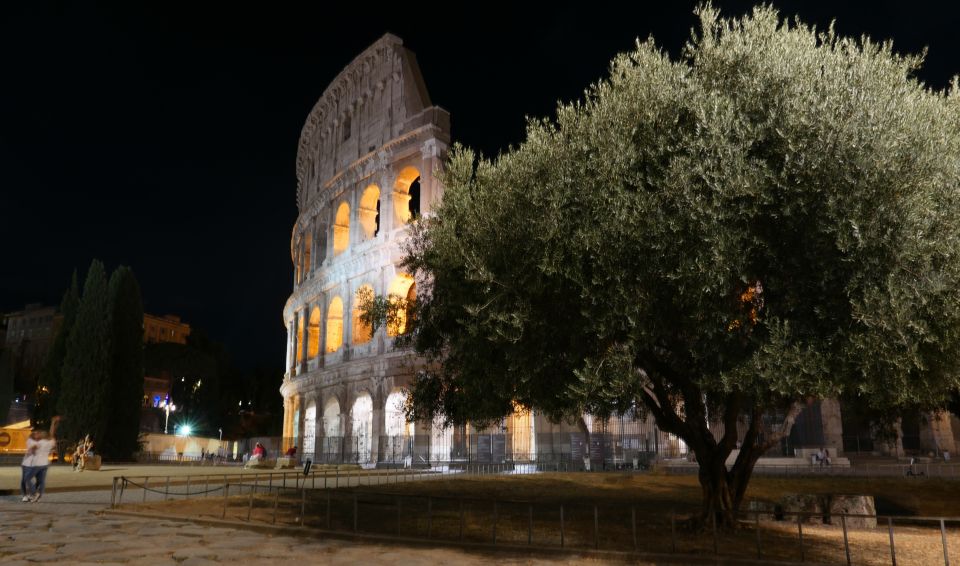
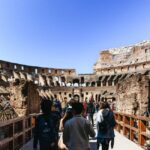
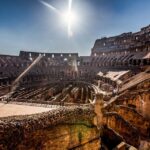
Your first major stop is the Colosseum area, with a guided segment of about 40 minutes. Since you won’t enter the building, you’ll use the outside views as a learning tool. That’s actually a smart approach for dusk, because you’re seeing the monument as Romans would have experienced it from the surrounding streets—part landmark, part arena district.
The guide explains how it was constructed, and that matters. When you understand the basic logic behind a stadium like this—its scale, its role, its design—you stop looking at it as just a photo background. You start asking better questions: Who came here? What was the atmosphere like? Why did the games land so deeply in Roman culture?
And yes, the tour talks about the brutal side: the bloody games and gladiator battles connected to the Colosseum’s fame. Even if you’re squeamish about violence, the point isn’t shock. It’s context—why emperors funded spectacle, why crowds gathered, and how power showed itself in public.
A practical tip: bring comfortable shoes because you’ll be on your feet for multiple stops, and the route is designed for walking rather than stopping long enough to catch your breath.
Arch of Constantine to the Forum: shifting from emperor branding to civic life
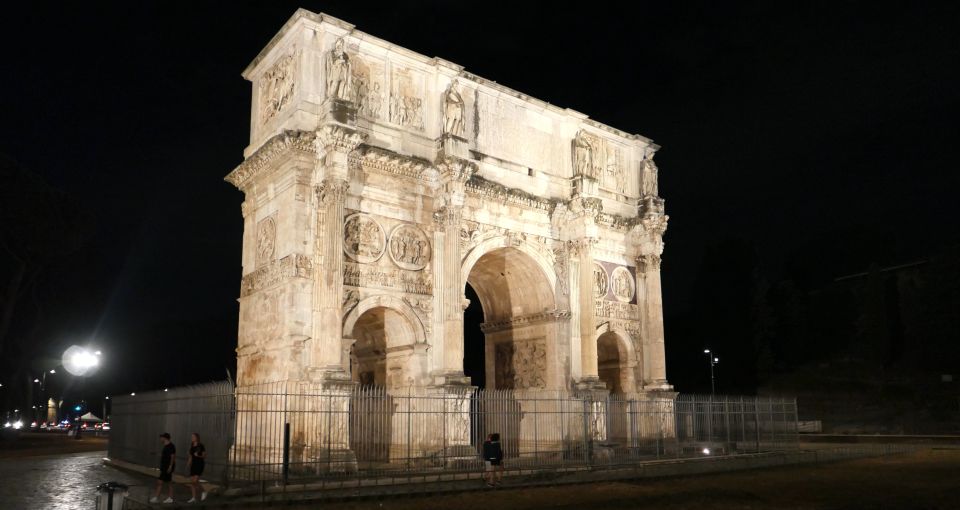
After the Colosseum, the tour moves to the Arch of Constantine for about 10 minutes. This is a quick stop, but it’s a useful one. Arches like this weren’t built just to look impressive; they were built to communicate. Even from the outside, you can connect the arch to the bigger theme the guide is teaching: emperors shaping public memory.
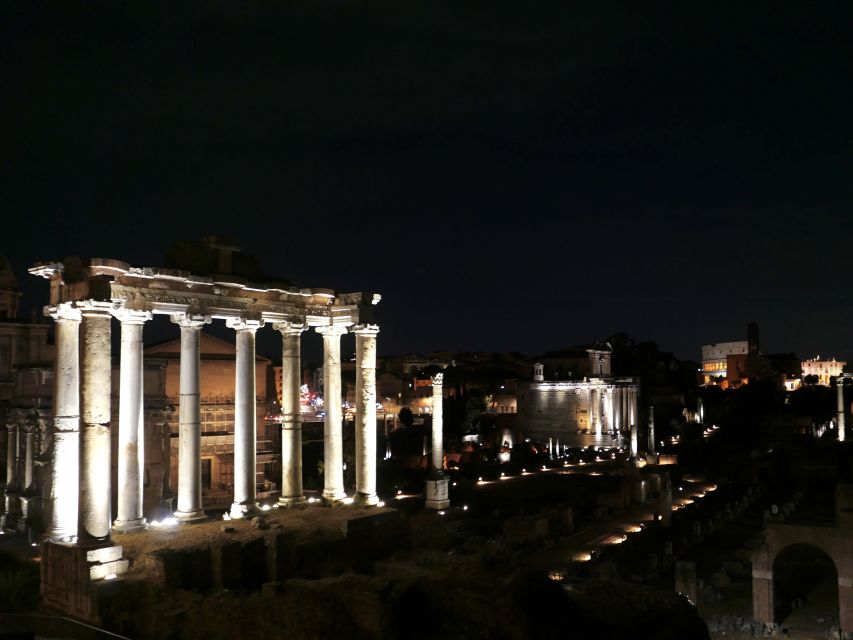
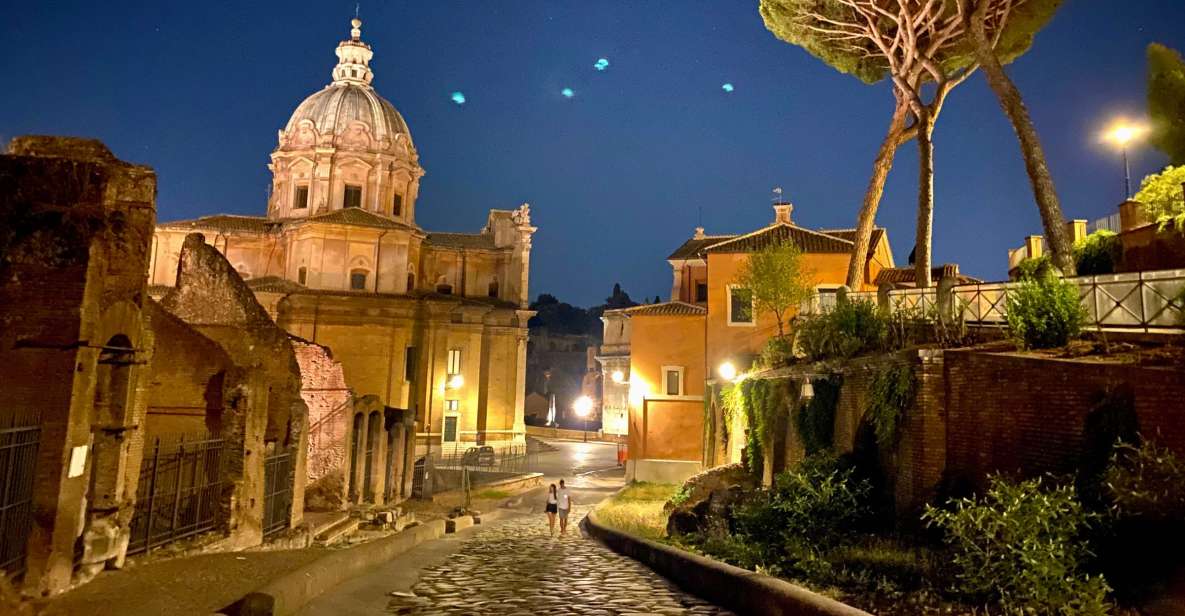
Then you head toward the Roman Forum under night light. This is where the tour does a nice job of “story sequencing.” You go from a place of entertainment and mass spectacle to the space tied to governance, politics, and everyday Roman civic life.
The transition matters because the Forum isn’t just a pile of ruins—it’s the stage where Roman leadership performed. When you understand that, the individual buildings start to feel like parts of one working system.

Roman Forum highlights: Temple of Castor and Pollux, the Arch of Titus, and the Senate House vibe
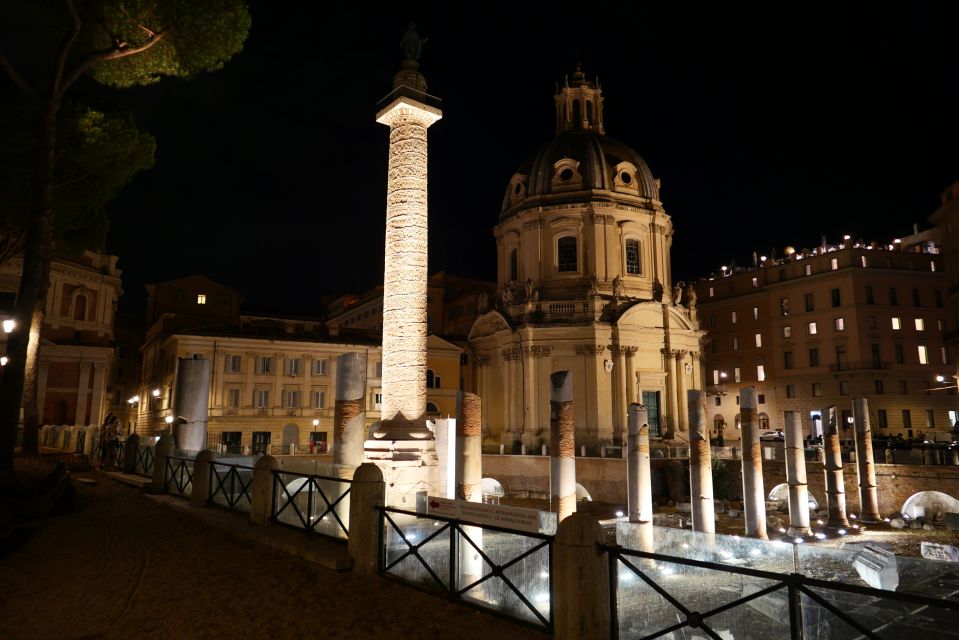
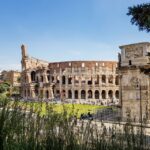
The Roman Forum stop runs about 40 minutes, and it’s packed with the kind of specific details that make ruins feel readable. You’ll look at the Temple of Castor and Pollux, the Arch of Titus, and the Senate House area, guided throughout.
What I like about this part is the way the guide links stone to people. Instead of saying, Here is a temple, you get the story behind the names and what they meant. You’re learning how Rome organized authority in public spaces—religion, government, and commemorations all overlapping in one district.
The Arch of Titus, in particular, is a good anchor point. It helps you connect the Forum to the broader imperial world. The guide also talks about notorious emperors and what life could feel like in those eras. That viewpoint keeps you from treating the Forum like ancient architecture class.
Dusk also helps here. You’ll still be surrounded by plenty of urban motion, but the evening mood makes it easier to focus. And since you’re not entering, you can look at sightlines and positioning: how buildings face each other, where movement flows, and why the Forum reads like a designed space rather than random ruins.
Trajan’s Forum and the Column of Trajan: a photo moment with actual context
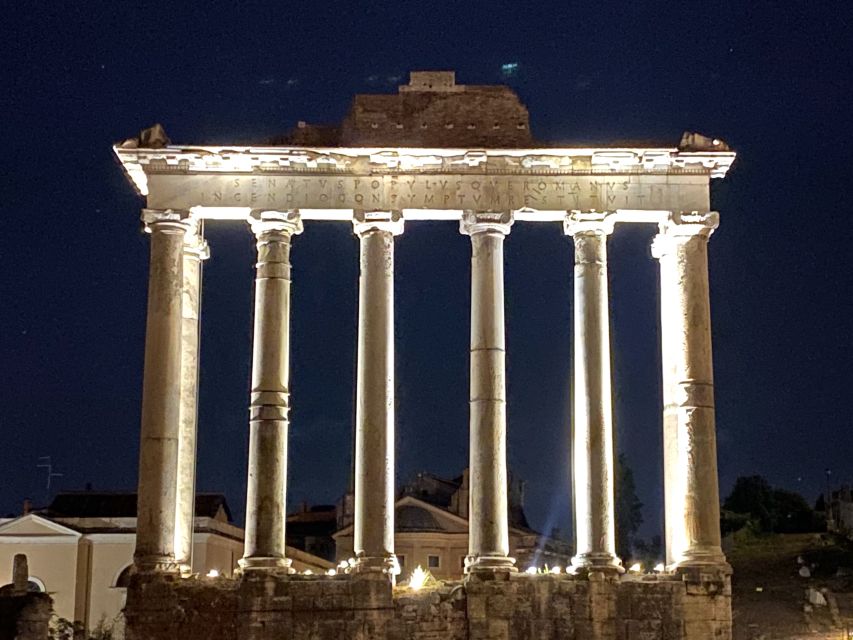
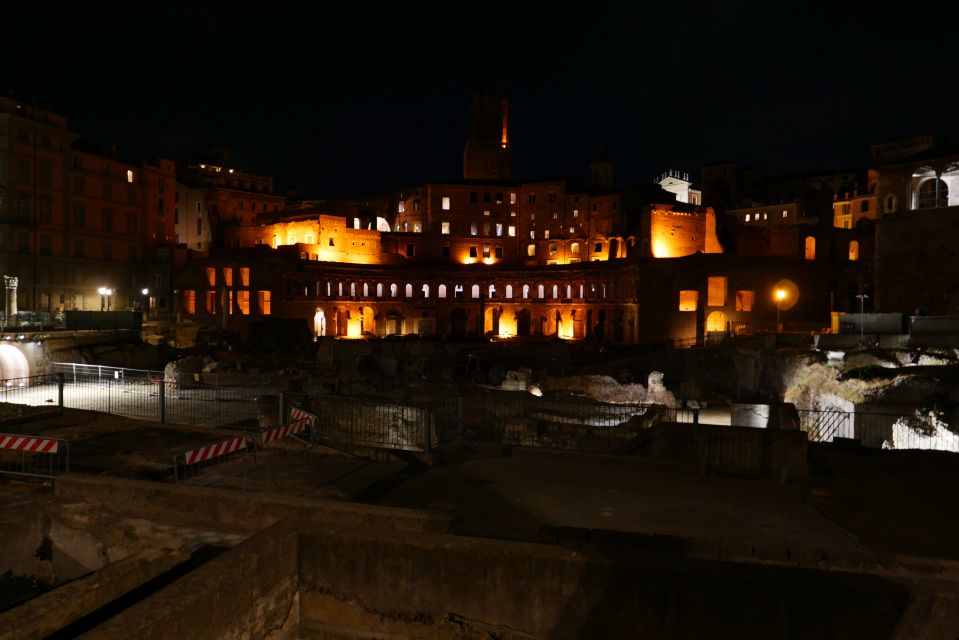
Next up is Trajan’s Forum for about 15 minutes. The main takeaway is the guide’s explanation of what you’re seeing in the context of imperial ambition.
You’ll get time to snap a photo in front of the Column of Trajan, which is a classic visual target. The key is that you’re not just taking a picture of a column—you’re stopping at a point that represents how Romans told stories using monuments. The guide ties it into the larger narrative of rule, messaging, and public identity.
This is also a good segment for anyone who likes short, concentrated stops. It’s not dragged out, but you still get the meaning behind what you’re looking at.
One consideration: since the tour remains outside-focused, you’re relying on the guide’s interpretation to bring the stones to life. If you want maximum hands-on access inside sites, you’ll still need separate tickets elsewhere—but for evening context, this portion delivers.
Capitoline Hill finale: getting your bearings from the top
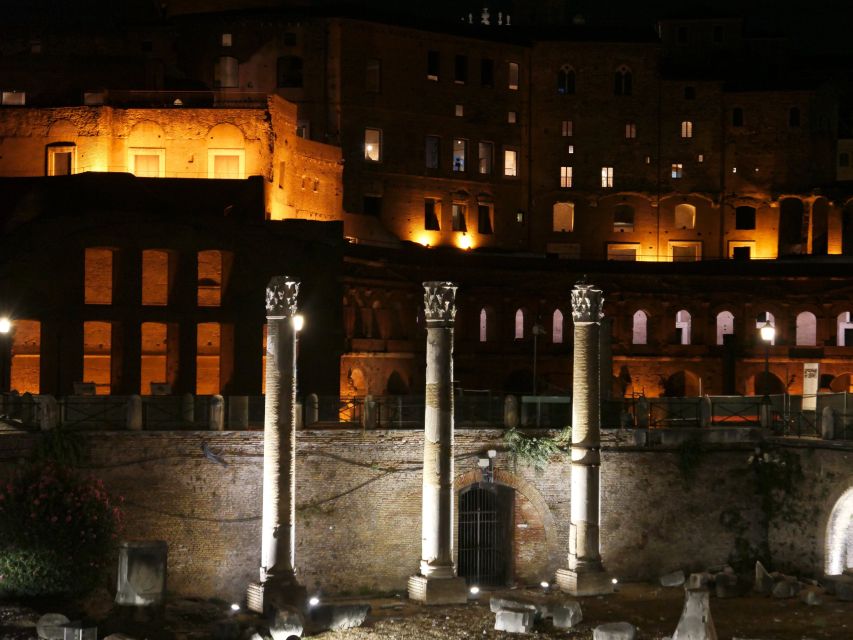
The tour finishes with a climb to Capitoline Hill and ends in Piazza del Campidoglio, with about 15 minutes there. This is a strong way to end, because the hill gives you a panoramic payoff: suddenly Rome feels connected again.
From the top, you can step back and understand how the Colosseum and Forum district relate to the rest of central Rome. It’s not just a view; it’s a “get your bearings fast” moment. And if you’ve spent the whole tour learning names and functions, the panorama helps those details lock into place.
Even better, the climb is timed so it doesn’t steal the show from the guided storytelling. You get the explanation, you get the walking, and then you get the view.
Guides and groups: what small group or private feels like
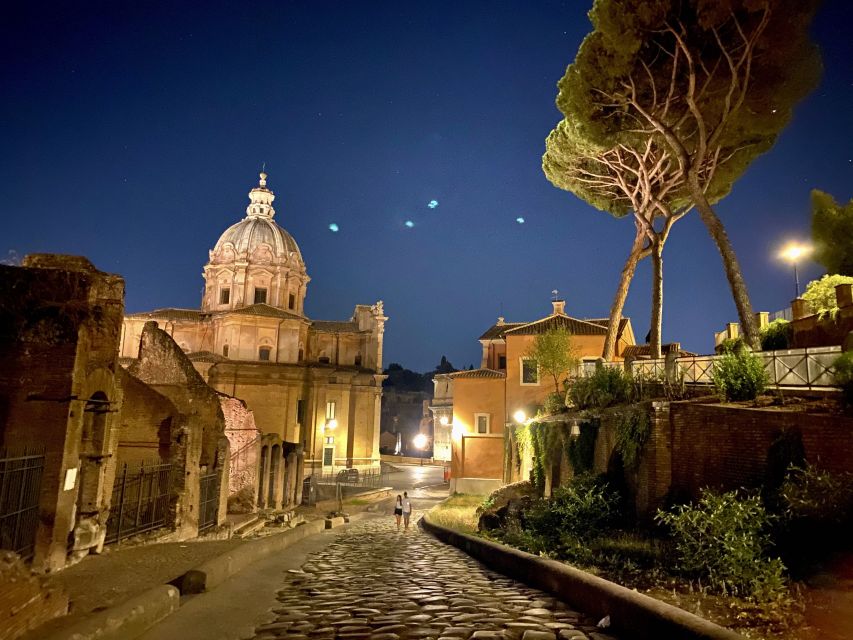
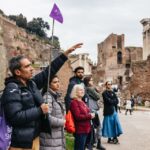
You can choose either a small group tour or a private tour. The small group option caps at 10 participants, which is a practical size for a night walk—enough people to add energy, but not so many that you lose the guide’s attention.
Tours are offered in multiple languages, including English, Italian, Spanish, Portuguese, French, and German. Hearing the details in your language isn’t a luxury here. Roman monuments have layers of meaning, and the guide’s job is to make those layers understandable on your feet.
Also, the tour uses sterilised headsets, which is a big deal in real life. At night, with street noise and moving groups, it’s easy to miss key points. With headsets, you’re more likely to stay engaged instead of playing catch-up.
In the broader feedback around this experience, guides like José and Matilde have been praised for making the two hours feel dramatically faster and for telling the Roman story in a way that keeps you interested. That’s exactly what you want from a short dusk tour: clear pacing and stories that stick.
Who this tour suits best (and who should skip it)
This is a strong choice if you want:
- A dusk walk that covers the biggest ancient sites without daytime crowds
- Guided context for the Colosseum area, Roman Forum highlights, and Trajan’s Forum
- Outside viewing with focused stops and a final hilltop panorama
- A smoother experience thanks to headsets and a pro guide
You might want to look elsewhere if:
- You strongly want to enter the Colosseum, Roman Forum, or Trajan’s Forum during this specific time window
- You dislike walking in the evening (even though the tour is only 2 hours, it is still a walk)
Should you book Rome: Wonders of Ancient Rome at Dusk?
Yes, I’d book it if your goal is to understand Ancient Rome fast, then use the rest of your trip to explore at your own pace. The outside-focused format is surprisingly effective at dusk because you’re learning the “what and why” while enjoying the mood of Rome after dark.
Skip or add on carefully if your top priority is interior access. This experience doesn’t include entry into the Colosseum, Roman Forum, or Trajan’s Forum. Think of it as the interpretation layer. Then, if you want the inside experience later, you can pair that with separate tickets.
One more reason to lean toward booking: you’re not stuck wandering. In 2 hours, you get a guided route that ends with a view from Capitoline Hill—so you leave with both stories and perspective.
FAQ
How long is the Rome: Wonders of Ancient Rome at Dusk tour?
The tour lasts 2 hours.
Does the tour include entrance into the Colosseum, Roman Forum, or Trajan’s Forum?
No. The tour does not include entrance into the Colosseum, Roman Forum, or Trajan’s Forum.
Where do I meet the guide?
Meet at the green kiosk at street level right outside the Colosseo metro station (Line B). Look for staff holding a yellow Touriks sign, and make sure you meet downstairs.
What languages are available for the live guide?
The live guide is available in Spanish, German, Italian, French, Portuguese, and English.
Is there a small group option, and how many people are in it?
Yes. The small group tour has a maximum of 10 participants.
Is the tour wheelchair accessible?
Yes, the tour is wheelchair accessible.
What should I bring?
Wear comfortable shoes, since you’ll be walking during the tour.
Does the tour run in rain?
Yes, it runs rain or shine unless weather conditions are very unsuitable. If canceled, you’ll be offered an alternative date or a full refund.