REVIEW · COLOSSEUM, FORUM & PALATINE TOURS
Ancient Rome: Archeological area Largo Argentina
Book on GetYourGuide →Operated by TOURISTATION · Bookable on GetYourGuide
Caesar’s shadow still sits here. This short visit to Largo di Torre Argentina puts you in a sacred archaeological area where Roman life kept unfolding for over 2,000 years, and where the Ides of March 44 BC assassination is tied to the ruins.
What I like most is the mix: you can see four temples dating roughly from the 4th to the 1st centuries BC, then shift your attention to the tuff base remains associated with the Curia of Pompey. I also appreciate the structure of the visit—there’s a 30-minute multimedia film to set the scene, plus an English app audioguide so you’re not just staring at stones.
The main drawback to consider: it’s not a full guided walking tour with a person leading you. It’s built around a multimedia program + audio, so if you want a talk-heavy guide, you’ll want to know that up front.
In This Review
- Key highlights you will actually feel
- Largo di Torre Argentina in plain terms (and why it matters)
- Before you go: check in at Touristation Aracoeli (and what you’ll need)
- The 30-minute multimedia film: what it’s doing for your visit
- Entering the excavations: the reserved access effect
- Four temples dating from the 4th–1st centuries BC
- Curia of Pompey tuff base and Caesar’s assassination site
- Rome’s layered life: imperial phases, then medieval structures
- What those excavations between 1926 and 1930 tell you
- Paper map, WiFi, and the app: how to use the included tools
- So is it worth $23? Value vs. expectations
- Who this experience suits best (and who might skip it)
- Should you book Ancient Rome: Archeological area Largo Argentina?
- FAQ
- How long is the Ancient Rome: Archaeological area Largo Argentina experience?
- Where do I redeem my voucher?
- What does my selected booking time refer to?
- Is the audio guide included, and is it in English?
- Is there a guided tour with a person?
- What is included besides the excavation entrance?
- Does the ticket include skip-the-line entry?
- What do I need to bring?
- Are pets or large bags allowed?
- Is free cancellation available?
Key highlights you will actually feel
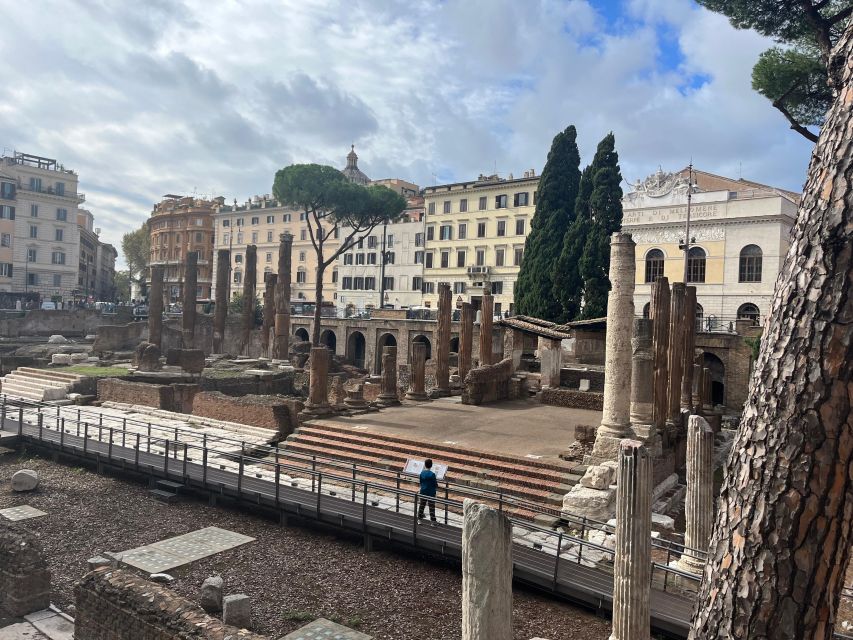
- Reserved entrance to the Largo Argentina excavations, instead of only looking through the fences
- 30-minute multimedia video that helps you picture what you’re seeing
- Four temple remains from the 4th–1st centuries BC in one compact site
- Curia of Pompey tuff-base remains connected to Caesar’s assassination (44 BC)
- Layered history: imperial phases, then medieval-age structures, all preserved in one spot
- An ancient island in the middle of modern Rome, surrounded by streets and daily noise
Largo di Torre Argentina in plain terms (and why it matters)
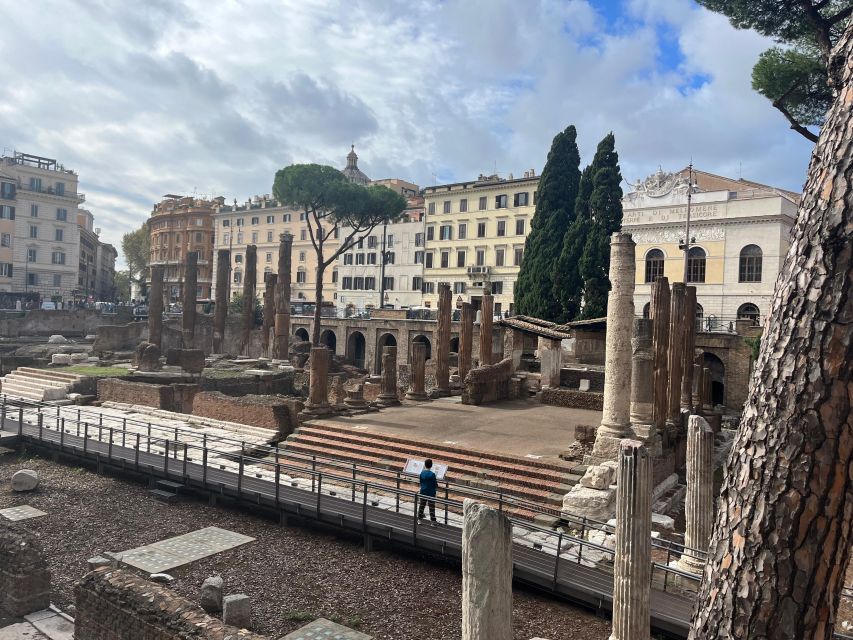
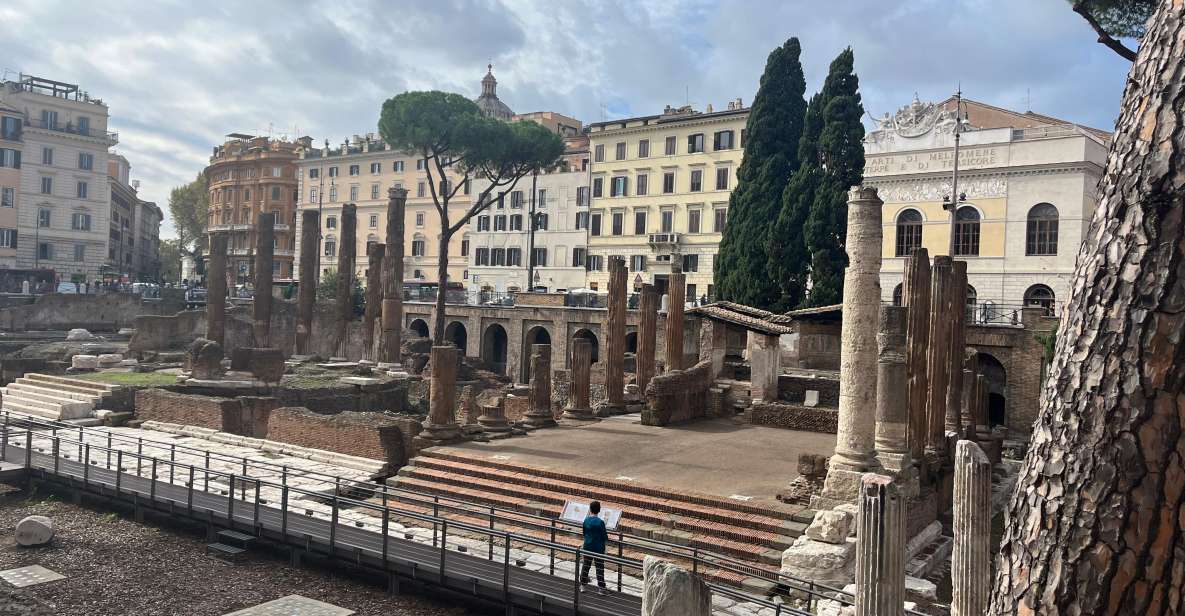
Largo di Torre Argentina is one of those Rome places where the city feels like it’s built directly on top of its own past. You’re in a sacred area that was lived in for about 2,000 years. That alone is enough to make the visit worthwhile.
But the emotional pull is stronger than that. This is tied to the darkest episode in Roman politics: the killing of Julius Caesar on the Ides of March in 44 BC, associated with the Curia of Pompey site. What makes it memorable is that you’re not getting the assassination as a distant trivia fact. You’re standing near physical remnants connected to it—remains that were uncovered during major work in the area.
And yes, the site is also visually cool. You walk around an archaeological space that feels like an island because of how it sits in the middle of the modern city layout. It’s a strange feeling—in a good way. One minute you’re in everyday Rome, and the next minute you’re in a fenced-off zone where architecture from centuries BC is still readable.
You can also read our reviews of more tours and experiences in Rome.

Before you go: check in at Touristation Aracoeli (and what you’ll need)
Your selected time is for check-in at the Touristation office in Piazza d’Aracoeli 16. Don’t aim your clock at the excavations themselves. That’s one of the easiest ways to lose time. If you arrive early, you’ll likely be waiting. If you arrive late, you may miss the flow of the visit.
Look for the office entrance with a fountain and orange flags in front—this helps you spot the right place fast.
What to bring:
- Passport (it’s explicitly required)
What you should leave behind:
- Pets
- Glass objects
- Luggage or large bags
- Alcohol and drugs
That list isn’t just paperwork. The excavations are a sensitive site, and the rules keep the area manageable when people come and go.
One small practical note: the office check-in is close enough to the site that you’re dealing with a short walk, not a long transfer. Plan to move on foot.
The 30-minute multimedia film: what it’s doing for your visit
This experience includes a 30-minute ancient Rome multimedia video. You should think of it as your “translation layer.”
Roman ruins can look confusing if you’re not sure what you’re looking at. The film helps you connect the names and dates—temples, sacred space, and the layers of occupation—to the actual layout you’ll see afterward. It’s especially useful for a site like this, where multiple centuries overlap in a small footprint.
It also makes the visuals more coherent. Instead of treating the ruins like a pile of old blocks, you start to notice how structures relate to one another: temple remains here, sacred space boundaries there, and the archaeological work that changed what you can see today.
Then, once you move into the excavation area, the English app audioguide keeps that momentum going. You’re not just watching a screen. You’re using audio while the stones are in front of you.
Entering the excavations: the reserved access effect
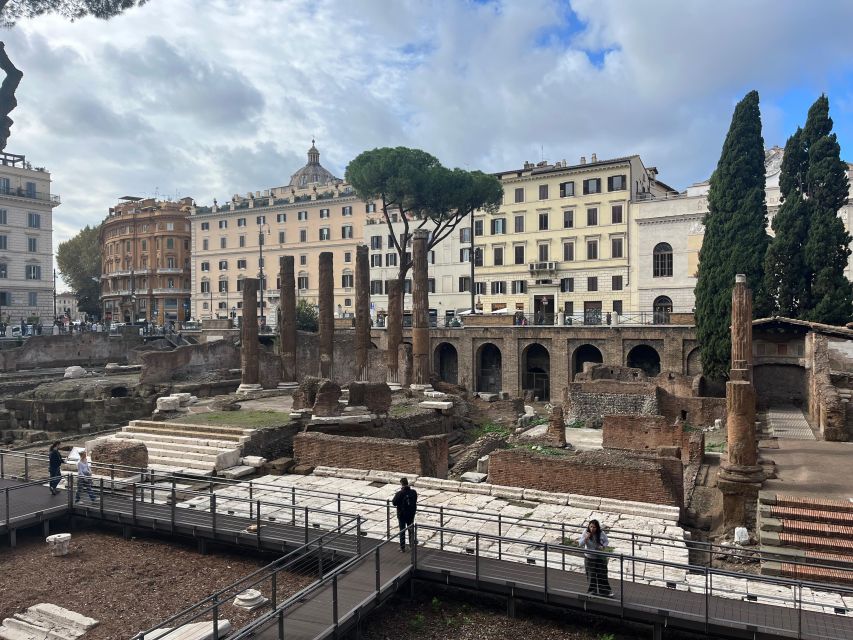
You get entrance reserved for the Largo Argentina excavations. Translation: you have a smoother path into the archaeological area than if you were trying to manage it on your own at the gate.
A realistic note, though: parts of Largo Argentina are visible from outside, and the overall site isn’t hidden. So the “value” of reserved access depends on what you want from the visit. If you’re happy with a quick look from the perimeter, you might feel the ticket is less necessary. If you want the full experience—standing inside the excavation space and focusing on the architecture and associated remains—this access matters.
I like the fact that it positions you where the storytelling actually takes place. It turns your time from sightseeing into a focused history walk, even though the visit is short.
Four temples dating from the 4th–1st centuries BC
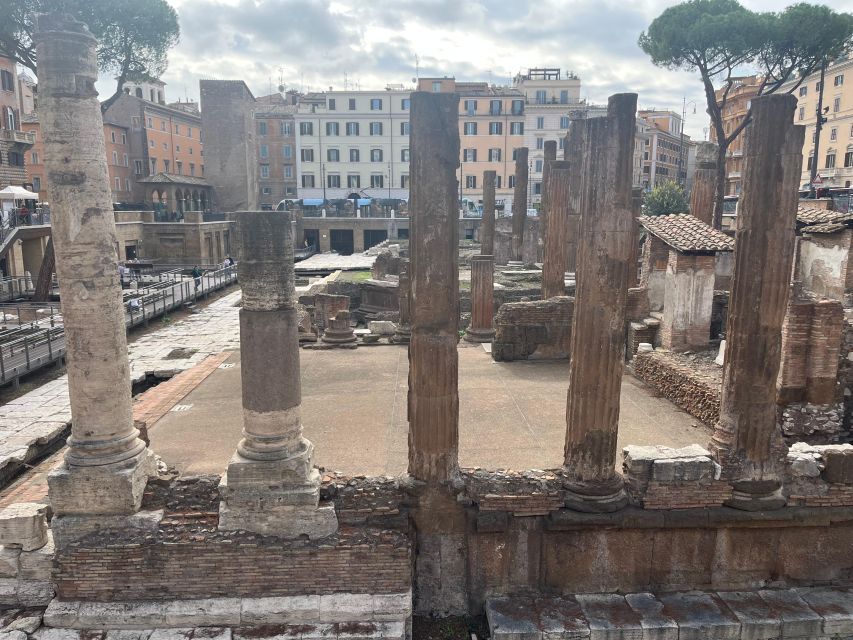
One of the best parts of the experience is the chance to admire the four temples dating from roughly the 4th to the 1st centuries BC. In a compact site, you’re essentially seeing multiple moments in the development of Roman sacred architecture.
Here’s why that matters for you: temples in Rome weren’t just buildings. They were part of civic identity—places where religion, politics, and public life overlapped. When you see remains from different centuries in the same area, you can feel how sacred space evolves instead of staying frozen.
During the visit, the experience focuses your attention on what’s still there—enough to recognize temple scale and layout even when major pieces are long gone. It’s not about pretending you’re seeing perfect originals. It’s about reading what survives.
If you’re the type of person who enjoys “how this was built” more than “who won what,” these temple remains give you exactly that. You’ll likely spend time looking for alignments, base shapes, and how the structures sit within the overall sacred precinct.

Curia of Pompey tuff base and Caesar’s assassination site
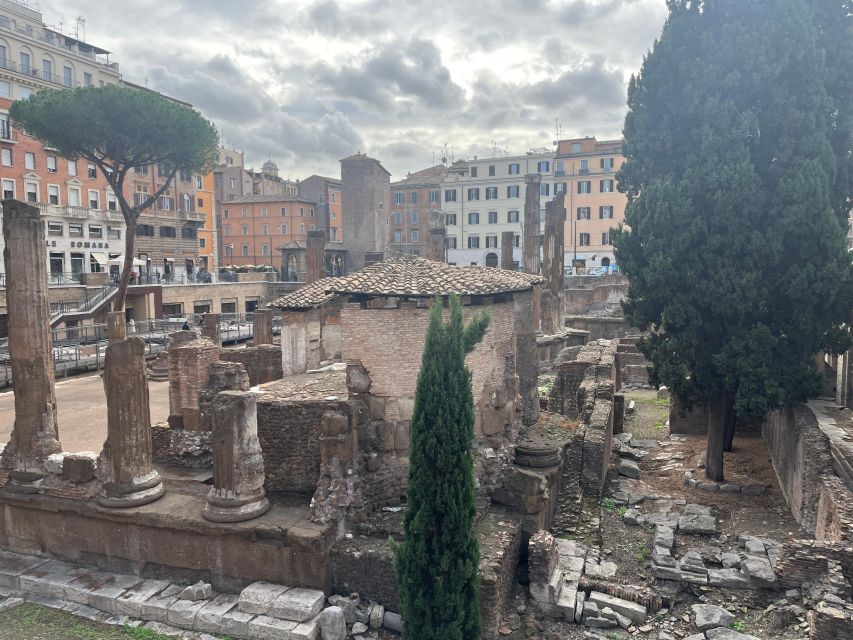
This is the reason most people care about Largo Argentina, and it’s handled thoughtfully in the experience.
You’ll see the remains that guard the tuff base of the Curia of Pompey, described as the site of Julius Caesar’s assassination on the Ides of March 44 BC, as reported by ancient sources.
A quick way to make this stick in your mind: stop trying to hunt for a dramatic battlefield scene. Instead, approach it like archaeology. Look at the base remains, understand that you’re seeing the physical anchor tied to later accounts. You’re standing in the place people associate with a turning point in Roman history.
This section tends to hit hardest if you’ve read at least a little about Caesar before arriving. But even without prep, the experience gives you the dates and the connection. The emotional effect comes from the contrast: the assassination matters because it changed power in Rome—yet what you see today is quiet stone and a preserved base.
Rome’s layered life: imperial phases, then medieval structures
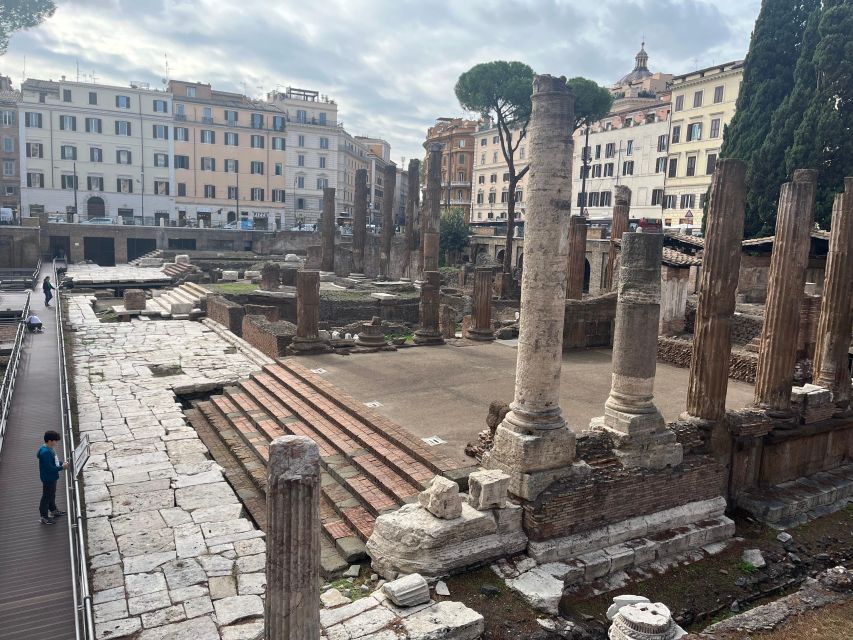
What I find especially satisfying here is the layering. The sacred area preserves testimonies of uninterrupted life for over 2,000 years. You’re not only dealing with the distant BC past.
The experience points out imperial phases of the temples, showing how earlier sacred structures were adapted over time. Then you get medieval-age structures, proving the area stayed meaningful long after the Roman world changed.
This is one of the quiet advantages of a site like Largo Argentina: it prevents the “one era only” mindset. Rome didn’t stop at the Republic or the Empire. It kept reusing, reshaping, and reinterpreting older spaces.
So when you walk through, you’re not just collecting facts. You’re watching continuity. It’s a reminder that cities survive by adapting what they already have.
What those excavations between 1926 and 1930 tell you
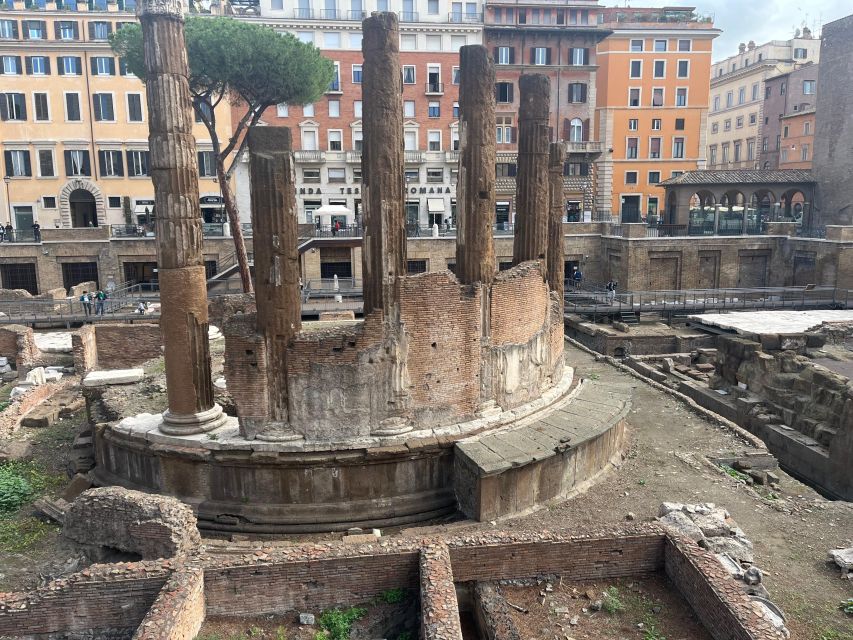
The site you see today wasn’t simply “discovered” and frozen in time. The area was affected by excavations and demolitions between 1926 and 1930, and that work shaped what became visible.
Why it matters for you: archaeological visibility is always tied to decisions made in the past. Here, those 1926–1930 interventions helped reveal structures—temples, remains, and layers—that you can now interpret.
Even if you don’t care about excavation history, it helps to know that you’re viewing a curated slice of the past: what was uncovered, what survived, and what was preserved for viewing. That context makes you read the site more carefully instead of assuming everything was always exposed.
Paper map, WiFi, and the app: how to use the included tools
Included with the experience are a paper city map and WiFi, plus the App Audioguide of Rome.
Here’s how I’d use that in your day:
- Treat the audioguide as your main companion during the site portion, especially for the Caesar-related area and temple remains.
- Use the paper map to connect what you just saw to the rest of the city. Largo Argentina is central, and it’s the kind of stop that pairs well with nearby sightseeing because it doesn’t require a long travel commitment.
WiFi sounds minor, but it helps if you rely on maps, translations, or the app interface while you’re moving.
So is it worth $23? Value vs. expectations
The price is listed at $23 per person, and the duration is 1 hour. That combination signals something important: this is a focused, short experience built around media and audio, not an extended deep lecture.
For value, I look at what you get that you wouldn’t get for free:
- You have reserved entrance to the excavations area
- You get the 30-minute multimedia video
- You get an English app audioguide
- You get a paper city map and on-site help at the meeting point
That’s the package. If your expectations are: I want a live guide wandering and answering questions for two hours—this isn’t that.
If your expectations are: I want to walk a compact set of ruins and understand what they mean, with help through audio and visuals—then the pricing starts to make sense. The site itself can be viewed from outside, so the “extra” you’re paying for is the inside look plus interpretation tools.
My rule of thumb: if you want context, buy in. If you only want quick photos, you may feel this is more ticket than you need.
Who this experience suits best (and who might skip it)
This works well if you:
- Like Roman politics and want to connect a famous event to a real place
- Prefer ruins you can read with the help of audio and a short film
- Want a high-impact stop that fits inside a busy Rome day
You might want to reconsider if you:
- Expect a guided tour with a person doing the talking (guided tour is listed as not included)
- Plan to rush and only want outside views
- Are sensitive to the idea of a short, structured visit rather than an open-ended museum-style wander
Should you book Ancient Rome: Archeological area Largo Argentina?
If you’re aiming for one “wow” stop that mixes architecture, Roman sacred space, and Caesar’s assassination connection, I think this is an easy yes—with one condition. Go in wanting interpretation, not just exposure.
Buy this if you want reserved excavation access and you’ll actually use the included English audioguide plus the 30-minute multimedia film. With that, the hour feels efficient and satisfying.
Skip or rethink it if your plan is mostly photos from street level and you don’t care about temple dates, layers of occupation, or the Curia of Pompey tuff base story. In that case, the site’s visibility from outside may already cover your needs.
FAQ
How long is the Ancient Rome: Archaeological area Largo Argentina experience?
The duration is 1 hour.
Where do I redeem my voucher?
You redeem your voucher at TOURISTATION ARACOELI, Piazza d’Aracoeli 16. There is a fountain and orange flags in front of the entrance.
What does my selected booking time refer to?
The selected time refers to the timing at the Touristation office in Piazza d’Aracoeli 16.
Is the audio guide included, and is it in English?
Yes. An App Audioguide of Rome is included, and the language listed for the experience is English.
Is there a guided tour with a person?
No. A guided tour is listed as not included.
What is included besides the excavation entrance?
You get a 30-minute ancient Rome multimedia video, reserved entrance for the Largo Argentina excavations, assistance at the meeting point, a paper city map, and WiFi.
Does the ticket include skip-the-line entry?
It is listed as including skip the ticket line.
What do I need to bring?
You need to bring a passport.
Are pets or large bags allowed?
Pets are not allowed, and luggage or large bags are not allowed.
Is free cancellation available?
Yes. Free cancellation is available up to 24 hours in advance for a full refund.